
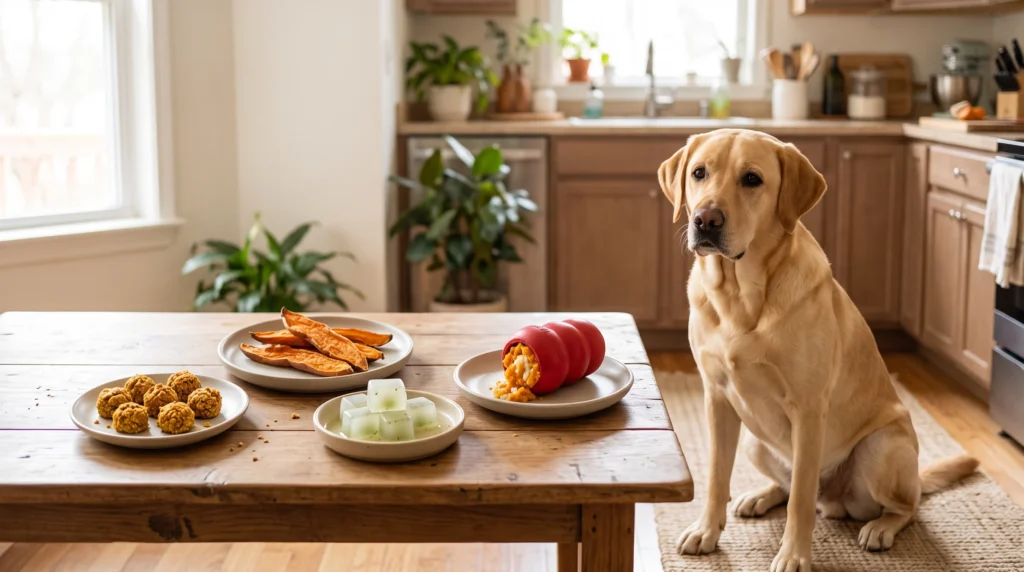
Every Lab owner knows the scene. You turn your back for ten seconds, and a sandwich, a sock, or half a tennis ball is gone. Labradors are famous for their endless appetite, and research has linked a gene variant (called POMC) to stronger food drive in many Labs. So your dog isn’t just being greedy. Food motivation is built into the breed.
The challenge is feeding that appetite without adding weight, upsetting the stomach, or encouraging more scavenging. The four recipes below are low in calories, made from safe whole ingredients, and designed to keep a Lab busy and satisfied.
Why Labs Need a Different Treat Strategy
Labradors gain weight easily, and extra weight puts stress on their hips, elbows, and joints. Because they will happily eat anything, treats should be:
- Low in calories, so you can reward often without overfeeding
- High in fiber or water content, so they feel full
- Slow to eat, so treat time lasts longer
- Made from simple ingredients, so there are no hidden fillers or additives
For more ideas on keeping rewards light, browse these low-calorie dog treats for overweight dogs.
Treat 1: Pumpkin Oat Bites
Pumpkin is full of fiber and water, which helps a dog feel full on fewer calories.
Ingredients
- 1½ cups oat flour
- ½ cup plain canned pumpkin (not pie filling)
- 1 egg
- 2 to 3 tablespoons water, as needed
Directions
- Heat the oven to 350°F (175°C) and line a baking sheet with parchment.
- Mix the pumpkin and egg, then stir in the oat flour until a firm dough forms. Add water only if it’s too dry.
- Roll into small balls, about the size of a hazelnut, and flatten slightly.
- Bake for 18 to 20 minutes until firm. Cool completely.
Keep the bites small. A Lab doesn’t care how big a treat is, so smaller pieces mean more rewards for the same calories.

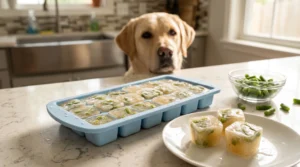
Treat 2: Frozen Green Bean and Broth Cubes
Green beans are a classic weight-management vegetable. They are crunchy, filling, and very low in calories.
Ingredients
- 1 cup chopped green beans (fresh or frozen, plain)
- 1 cup low-sodium chicken or beef broth (no onion or garlic)
Directions
- Steam the green beans for 5 minutes, then cool.
- Place a few pieces in each compartment of an ice cube tray or silicone mold.
- Pour the broth over the beans and freeze for at least 4 hours.
Frozen treats take longer to eat, which suits a dog who usually inhales everything. They are also useful on hot days. Always check that the broth has no onion or garlic, since both are toxic to dogs.
Treat 3: Baked Sweet Potato Chews
These chewy strips take longer to finish than a standard biscuit, and sweet potato adds fiber, vitamin A, and natural sweetness.
Ingredients
- 2 medium sweet potatoes
Directions
- Heat the oven to 250°F (120°C).
- Wash the sweet potatoes and slice them lengthwise into strips about ¼ inch thick.
- Arrange on a lined baking sheet and bake for 2½ to 3 hours, flipping once, until chewy but not brittle.
- Cool fully before serving.
With only one ingredient, these are a good choice if your Lab has a sensitive stomach. Cut the strips into smaller pieces for training.Homemade chewy baked sweet potato strips for dogs on a parchment-lined baking tray.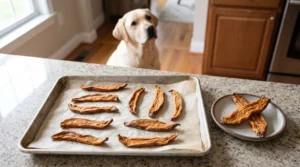
Treat 4: Stuffed Kong Mash
When a Lab is bored, the furniture can suffer. A stuffed Kong turns a few minutes of eating into a long mental workout.
Ingredients
- ½ cup plain canned pumpkin
- ¼ cup plain unsweetened yogurt (if your dog tolerates dairy)
- 2 tablespoons mashed banana
- 1 tablespoon xylitol-free natural peanut butter
Directions
- Mix everything in a bowl until smooth.
- Spoon the mixture into a rubber Kong toy.
- Freeze for at least 3 hours.
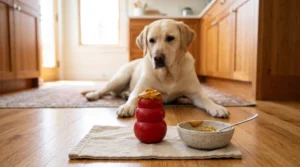
Peanut butter is calorie-dense, so keep the amount small. Check the label for xylitol, which is highly toxic to dogs. For more filling ideas, see these best stuffed Kong recipes.
How Many Treats Should a Lab Get?
Treats should make up no more than 10% of daily calories. Most adult Labs eat roughly 1,000 to 1,400 calories a day depending on size, age, and activity, so that leaves about 100 to 140 calories for treats. Your vet can give you a more exact number.
A few habits help:
- Use part of your dog’s regular kibble as a reward.
- Break treats into pea-sized pieces.
- Count treats toward the daily total, not on top of it.
- Weigh your dog regularly. You should be able to feel the ribs without pressing hard.
Keeping a Food-Obsessed Lab Safe
A Lab who eats everything needs a few extra precautions:
- Know the dangerous foods: chocolate, grapes and raisins, onions, garlic, macadamia nuts, and anything containing xylitol.
- Secure the trash and counters. Prevention works better than training alone.
- Use slow feeders or puzzle bowls to stretch out mealtimes.
- Call your vet right away if your dog swallows a toy, a sock, or other non-food item. Labs are prone to intestinal blockages.
Storage Tips
- Pumpkin oat bites and sweet potato chews: up to 5 days in an airtight container, or up to 2 weeks in the fridge
- Frozen cubes and Kong mash: up to 3 months in the freezer
These recipes contain no preservatives, so discard anything that smells off or looks moldy.
Pairing Treats with Training
Labs are eager to please, and food makes them very trainable. Use these treats to reinforce “leave it” and “drop it,” two commands that matter for a dog who grabs everything. Short, frequent sessions with tiny rewards work better than a few long sessions. Larger dogs also have different needs, so these large breed dog treat recipes are a good next read.
Frequently Asked Questions
Why is my Labrador always hungry?
Many Labs have a genetically strong food drive. If your dog seems unusually ravenous or is losing weight, check with your vet to rule out medical causes.
Are these treats safe for puppies?
Most are fine in small amounts, but puppies have sensitive digestion, so ask your vet first.
Can I swap the egg in the pumpkin bites?
Yes. Use two extra tablespoons of pumpkin or unsweetened applesauce.
What if my Lab has food allergies?
Introduce one new ingredient at a time and watch for itching, loose stools, or vomiting.
Final Thoughts
You can’t change a Lab’s love of food, but you can work with it. Low-calorie, filling treats that take time to eat keep your dog happy, active, and at a healthy weight. Start with one recipe, watch how your dog responds, and adjust from there.